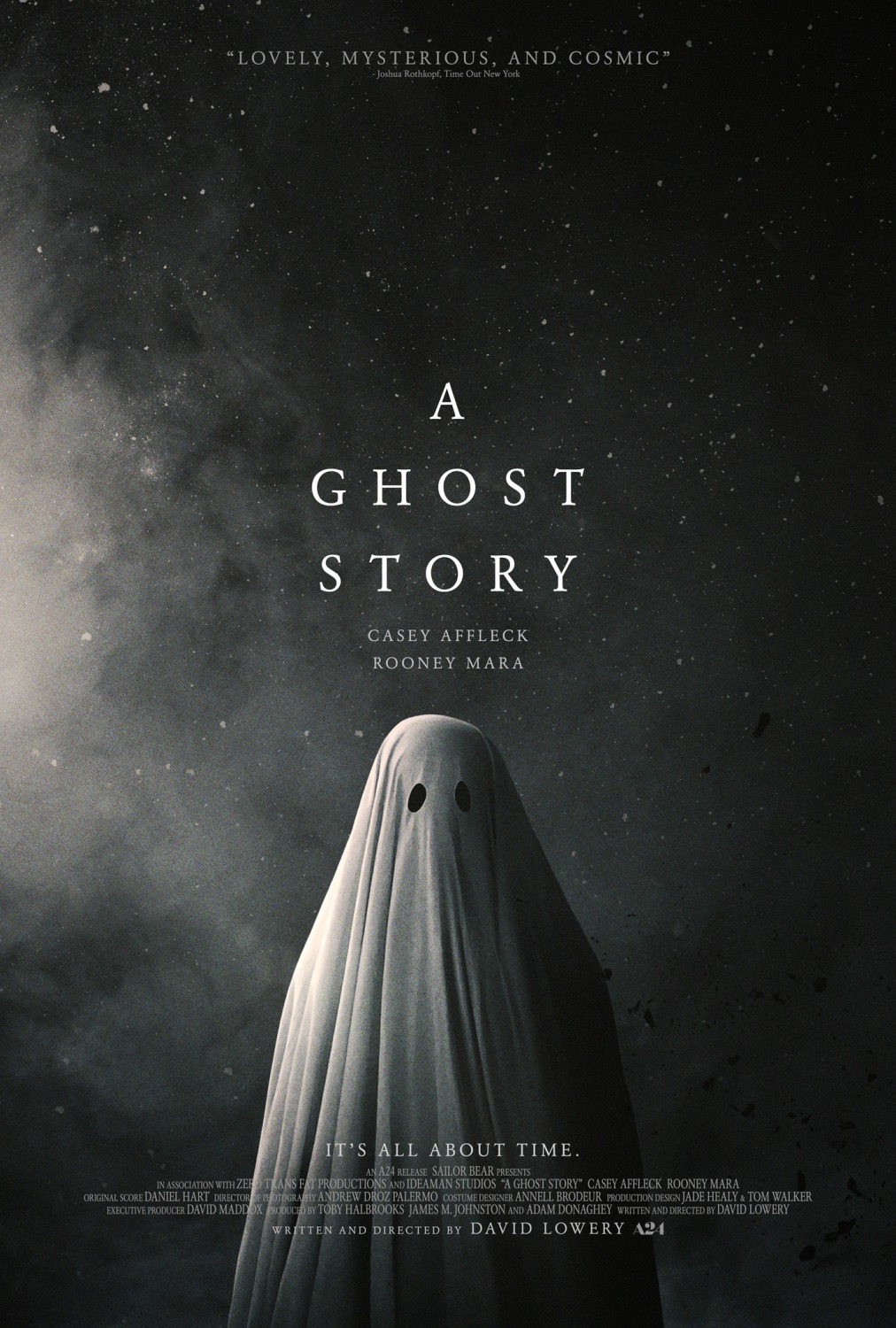
David Lowery’s “A ghost story” aims to be an eerie, distinct and evocative tale. With loss being Lowery’s cinematic substance, he attempts to create a tragic documentation of death. The film emphasises, rather well, the entrapment of death, as well as death’s malicious effects on it’s loved ones. However, the film lacks the ability to stimulate, for the majority.
The film’s strong suit is its ability to create an emotional engagement with the audience in regards to the ghost’s entrapment. For the duration of the film, the ghost is stuck in a horrifying cycle of isolation and being, forced to watch life move forth without him like a sick nightmare. This portrayal of death is striking and terrorising, forcing a sense of fear towards the inevitable, enabling the audience to emotionally invest in the film.
The film also manages to pry an emotional response from its audience through its portrayal of forgetting in death. In a few scenes, the ghost is seen conversing with another ghost. This other ghost says that he cannot remember who he is waiting for, but he doesn’t think they are coming back. This exceptional dialogue is nothing short of agonising, and shows Lowery’s ability to corrupt his audience with the painful aftermaths of death; such as moving on and becoming forgotten. Though the film is able to be complimented in this respect, this evocation and engagement that makes this movie special and memorable is short lived.
The house in which the ghost resides, begins to receive many, new occupants through the years, to which the ghost is obliged to live with. Thus, this image of entrapment, isolation and incredible evocation, quickly becomes stale. Instead of being provoking, it becomes boring and directionless, and the film quickly becomes a simple recyclement of images and ideas. Boredom also seeps from the film being mostly shot in silence, thus, after a ridiculously short time, one becomes uninterested in a film that has nothing to say or offer anymore.
The biggest issue with this film, lies within its inability to create a feeling of sadness for the ghost’s wife’s loss and vice versa. Naturally, we are supposed to feel sorry for the ghost, and for his wife, and Lowery seemingly attempts to do this by showing shots of the wife crying, and flashbacks of their relationship together. However, it is with difficulty, to buy into this attempt, to feel the pain of loosing someone you love, because, truthfully we do not see much ‘love’ between the two. This is so as in the scenes they have together, there does not seem much communication, or feeling. They instead seem disconnected and unfeeling towards one another, in disagreement or detached. Thus, the film’s attempt to show the pain that death inflicts, is felt only within the ghosts limbo, and thus it is hard to hold any emotion towards the fact that his life is over, we feel only emotion towards the fact that he lacks peace, and that seems to be on the contrary to the film’s intent.
Though “A ghost story” has received critical acclaim, its rather hard to comprehend why for the most part. Its positive reception can be understood for its ability to evoke, but the majority of the film seems directionless, and only serves to bore as it unfolds.
 MUSIC AND FILM FREAK REVIEWS